
The Perfect Software for Modern Datacenters
In today’s enterprise, the datacenter is no longer just a cost center. It is the operational backbone of revenue, customer experience, and competitive advantage. Yet most CEOs still inherit the same painful reality: networks that are too complex, too fragile, and too dependent on a small number of highly specialized engineers.
Gartner estimates that more than 65% of enterprise networking activities remain manual — even though nearly every enterprise already runs multiple automation tools. That gap is not a technology curiosity. It is a strategic constraint.
The Real Cost of the Status Quo
Every change carries risk. Every audit creates scramble. Every multi-vendor environment multiplies complexity. As AI workloads, hybrid cloud, and zero-trust mandates accelerate, the gap between what the business needs and what traditional network operations can deliver continues to widen.
The analyst data is unambiguous:
- Gartner projected that only 30% of enterprises would automate more than half of their network activities by 2026 — up from under 10% in mid-2023. Most organizations are still on the wrong side of that line.
- Gartner separately estimates that only about one-third of network tasks are actually automated today.
- Organizations that fail to adopt agentic NetOps will overspend by 25% on network management by 2030, according to Gartner.
These are not technical problems. They are constraints on speed, resilience, and margin.
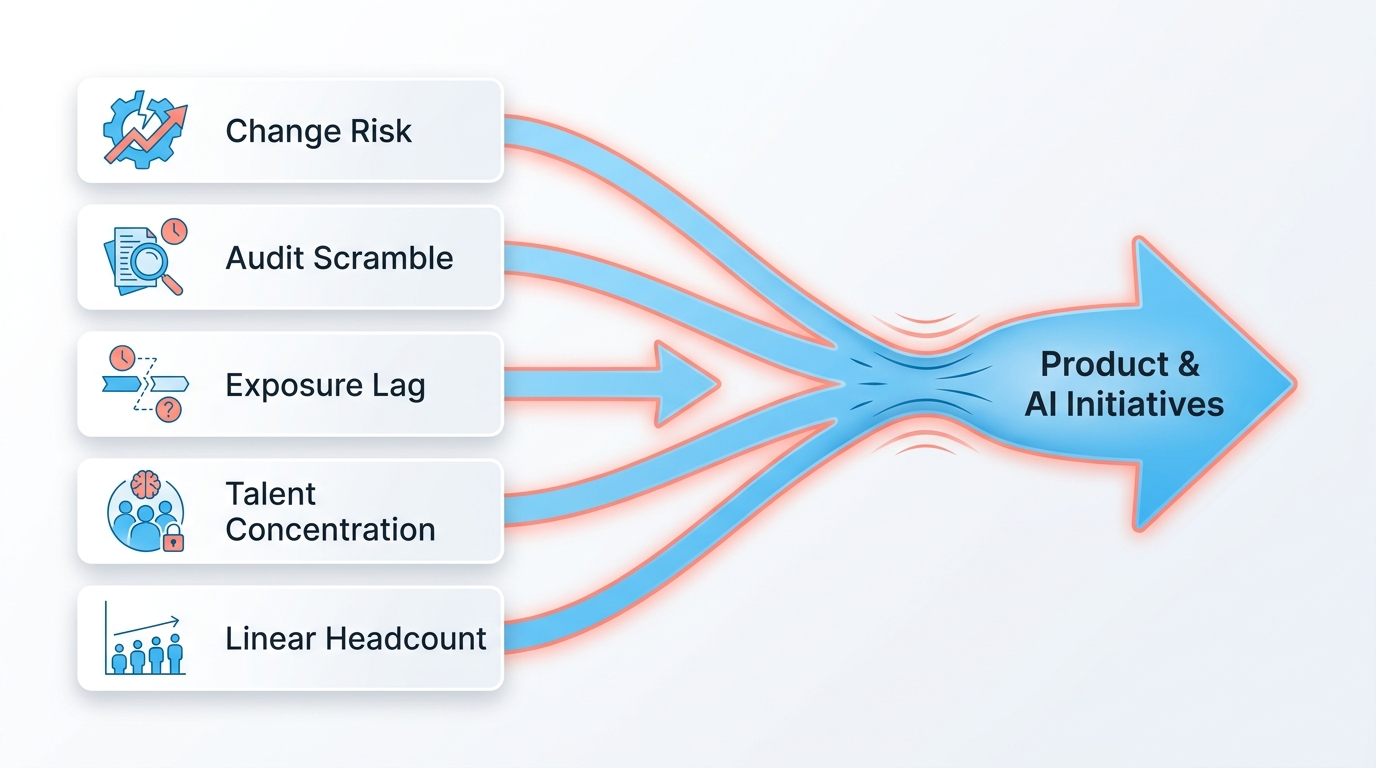 The status-quo cost stack: five operational constraints that end up throttling product and AI initiatives.
A Different Approach: Rehearse First, Then Ship
Regnor™ by AutomateNetOps takes a fundamentally different posture. Instead of treating production as the only environment where real work happens, it lets teams clone a live slice of production into a high-fidelity lab, rehearse the exact workflow against it, validate outcomes, and only then push changes — with full audit evidence attached.
This single capability changes the risk equation. Changes that previously required weekends, war rooms, and crossed fingers can now be proven safer before they ever touch production.
That matters because Gartner’s 2026 Market Guide for Network Automation Platforms describes a market shifting from purely deterministic workflows to hybrid models that combine deterministic execution with probabilistic, agentic automation — and from configuration files to spec-driven intent plus automated testing. Rehearsal against a production clone is how that shift becomes operationally safe.
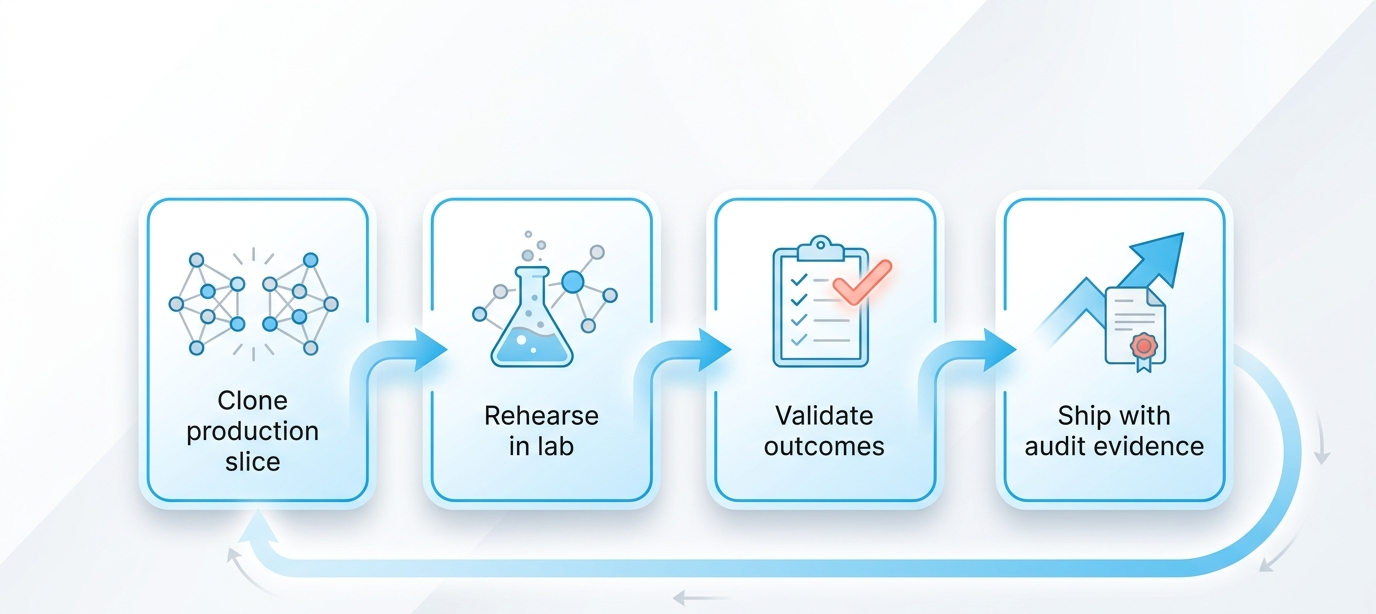 The rehearse-first loop: clone, rehearse, validate — and only then ship, with evidence attached.
Built for the Way Modern Datacenters Actually Operate
Zero-trust by architecture, not by policy. Credentials never leave the organization’s own infrastructure. The Valdis™ agent runs on-premise, connects outbound only, and integrates with HashiCorp Vault. Cloud convenience without the usual security trade-off.
AI that actually participates in the work. Engineers can describe intent in plain English and receive generated workflows. The same AI assists with troubleshooting and intent validation before execution. Support spans leading models and local LLMs — giving organizations control over data residency and cost.
Gartner’s strategic planning assumption is that by the end of 2027, 80% of network automation platform vendors will introduce agentic AI capabilities, up from less than 20% in early 2026. Looking further out, Gartner predicts that by 2030, 50% of organizations will use agentic NetOps with minimal human involvement, up from nearly 0% in 2025. The window to choose a platform that was designed for this shift — rather than retrofitted — is now.
Compliance as continuous evidence, not a project. Tavrin™ delivers DISA STIG and CIS Benchmark templates, automated validation, and WORM-sealed evidence. Auditors receive forensic-grade trails instead of screenshots assembled under pressure.
Multi-vendor reality accepted. Cisco, Juniper, Palo Alto, Aruba, and a wide range of others are supported through the protocols and libraries network teams already trust. The platform does not force a single-vendor monoculture.
Living operational intelligence. Topology maps stay current. Documentation regenerates from the platform itself rather than drifting into obsolescence. The result is reduced knowledge-concentration risk and faster onboarding of new talent.
What This Means for the Business
For a CEO, the value is not measured in node types or protocol support. It is measured in outcomes:
- Lower operational risk and fewer high-severity incidents
- Faster, safer delivery of infrastructure changes that support new products and AI initiatives
- Reduced dependency on scarce specialist labor
- Stronger compliance posture with less manual effort
- A clearer path to scaling network operations without proportional cost growth
Gartner’s CEO survey found that 80% of CEOs expect AI to force a high-to-medium change in operational capabilities, shifting the focus from digital business to autonomous business. At the same time, only 28% of AI use cases in infrastructure and operations fully succeed and meet ROI expectations. The difference is not more AI. It is AI embedded in governed workflows, with rehearsal, audit evidence, and credentials that never leave the network.
Gartner also notes that in 2028, more than half of data center switch spending will support AI workloads, up from less than 30% today. The fabric that carries those workloads cannot remain 65% manual.
The Strategic Question
Datacenter infrastructure is becoming more critical at the exact moment it is becoming harder to operate with traditional methods. Organizations that continue treating network automation as a collection of scripts and tribal knowledge will face rising risk and rising cost. Those that treat it as a governed, AI-augmented, zero-trust platform will move faster with greater confidence.
Regnor™ was built by network engineers with decades of production experience and is built on patent-pending technology. The platform is in beta — signups are open; we onboard teams in cohorts.
For leaders who view their datacenter as strategic infrastructure rather than a necessary evil, this is the category of software worth evaluating now — before the next major change window, the next audit cycle, or the next unexpected outage forces the issue.
Next step: Join the beta waitlist at automatenetops.ai/beta. Tell us about your environment; we will follow up when your cohort opens.
Tags: beta, compliance, datacenter, executive, multi-vendor, network-automation, regnor, tavrin, valdis, zero-trust
Categories: Business, Network Automation
Updated:
You may also enjoy

For the better part of a decade, the narrative in network operations has been one of steady improvement. We built better sensors. We deployed faster probes. ...

Most AI employees get fired in year one — canceled for cost, unclear value, or missing risk controls. The difference between a pilot and a workforce is wheth...
About Me

Featured Articles

Ready to Automate?
See how AutomateNetOps.AI can transform your network operations with zero-trust security.