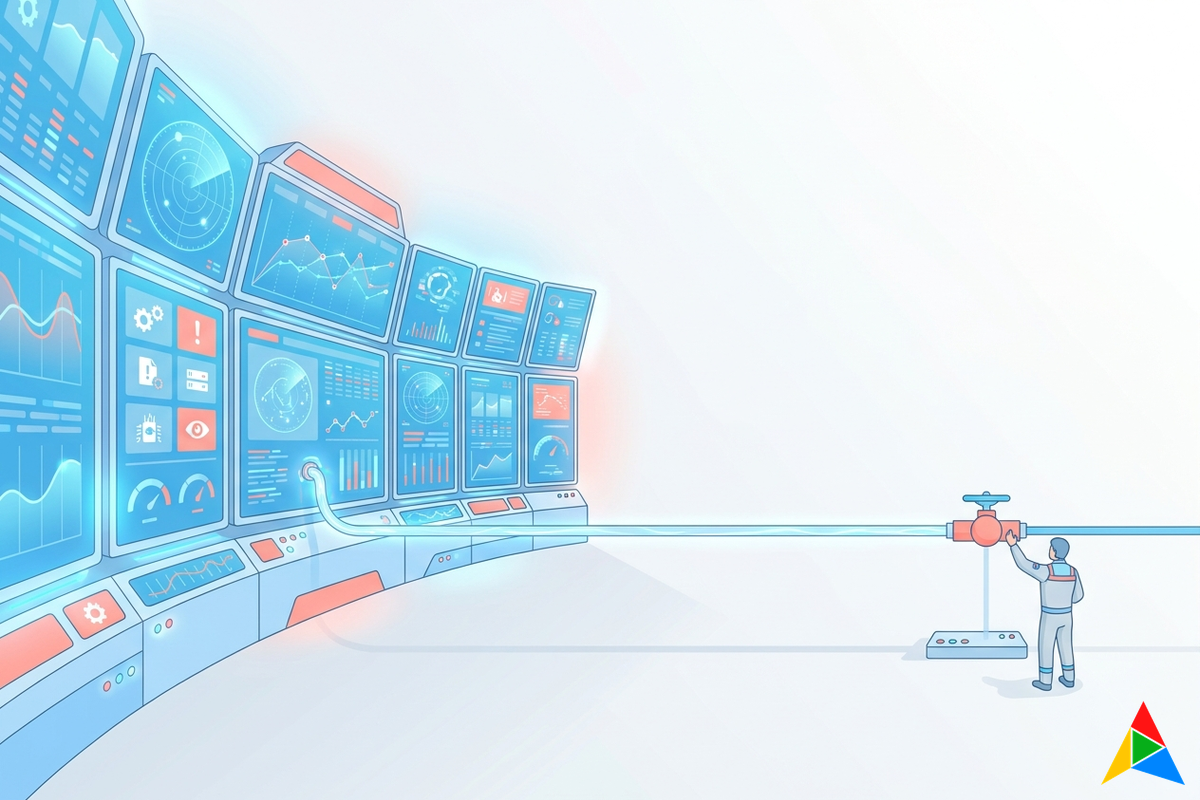
When Detection Outruns Remediation
For the better part of a decade, the narrative in network operations has been one of steady improvement. We built better sensors. We deployed faster probes. We integrated telemetry pipelines that ingest millions of data points per second. The result was a massive leap in detection. We can now see the hairline fracture in a BGP session, the subtle latency spike in a data center interconnect, or the silent misconfiguration on a router edge before it impacts a single user.
But there is a growing, uncomfortable truth that engineering managers are facing in their quarterly reviews: we have solved the problem of seeing the fire. We have not solved the problem of putting it out.
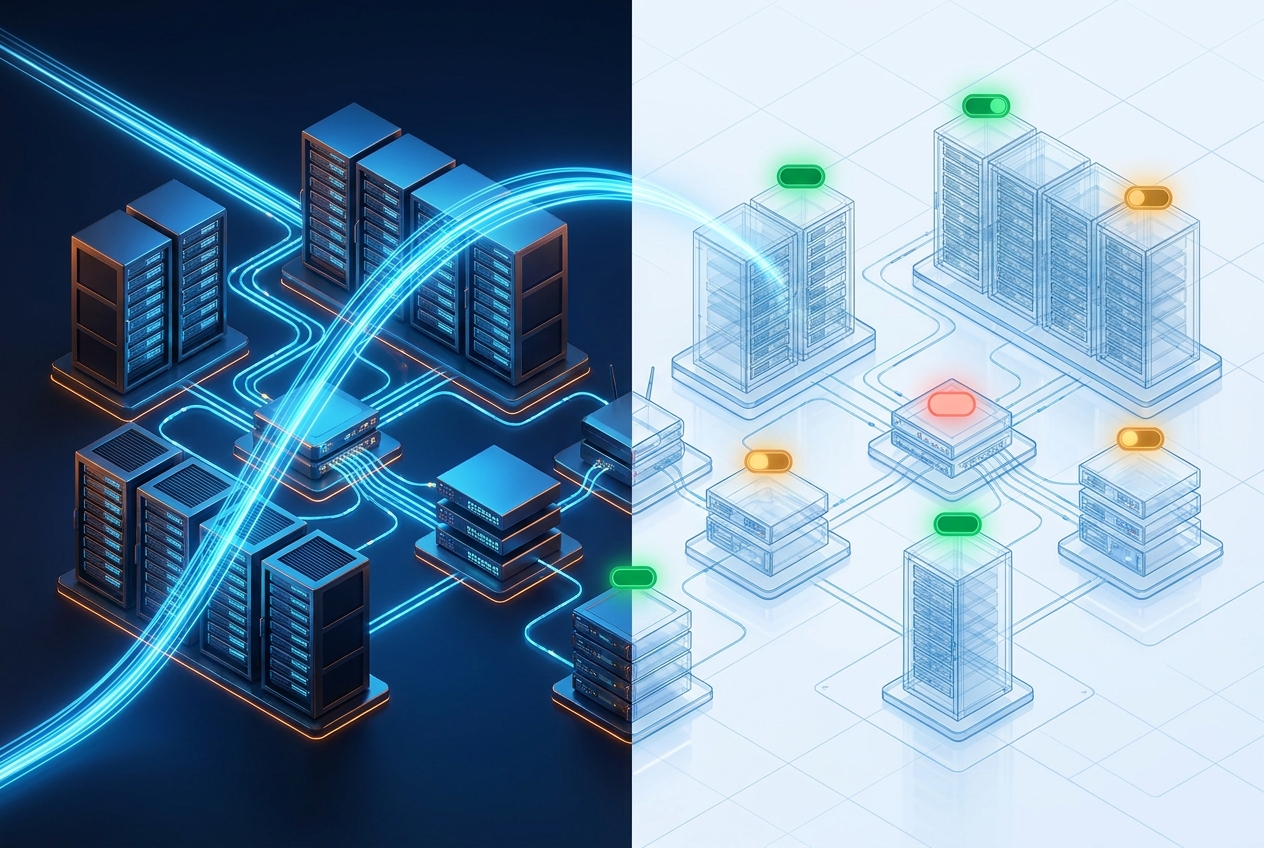
In many modern NOCs there is a widening chasm between the moment an issue is identified and the moment it is safely resolved. This is the detection/remediation asymmetry. AI-assisted monitoring has accelerated the identification of network issues to a speed that human teams can no longer safely match. Detection has evolved; remediation has stagnated. The scarce resource in modern NetOps is no longer visibility. It is governed remediation — the ability to execute drift correction, compliance fixes, and rapid patching through workflows that a security team can actually approve.
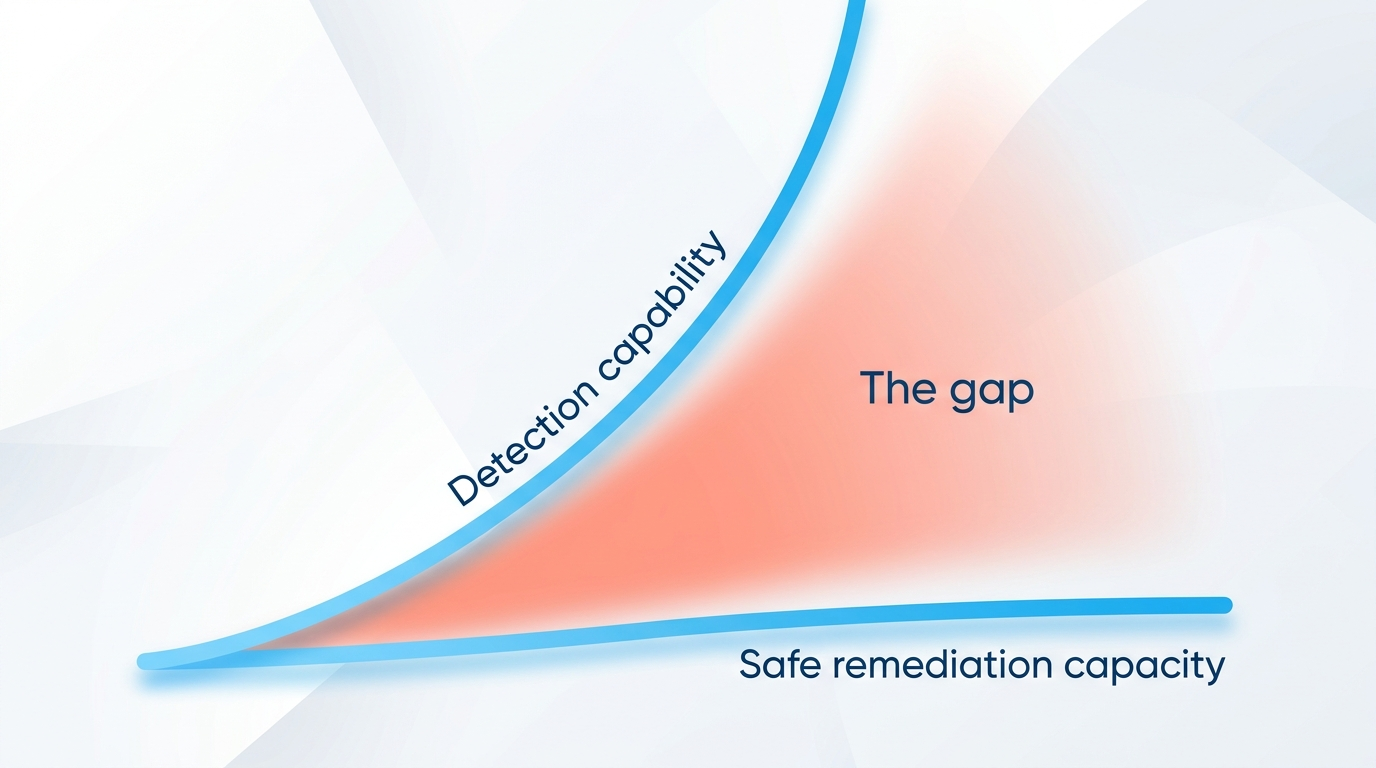 The asymmetry in one picture: detection keeps accelerating; safe remediation capacity barely moves.
The Widening Gap: Why Speed Without Safety Is a Liability
Modern observability is no longer just threshold alerts. It is intent-based networking and AI-driven anomaly detection. These systems don’t just tell you a link is down; they tell you that the pattern of traffic suggests a routing loop that will destabilize the core in four minutes. Valuable — but it creates a paradox: the faster you detect an issue, the less time you have to react.
Historically this was manageable. An engineer received an alert, SSHed into a device, checked the configuration, applied a fix. The manual loop was slow, but it was safe because the engineer was present in it. Today, alert volume and hybrid-cloud complexity have made that loop obsolete. You cannot manually remediate a config drift issue that appears on hundreds of endpoints simultaneously.
Simply automating the fix is not the answer either — naive automation often makes the risk worse. If a “self-healing” script detects drift and reverts to a baseline, but that baseline was itself compromised, you have just automated the spread of a vulnerability.
The gap widens because config drift response requires more than speed. It requires certainty. In a regulated environment you cannot simply “try” a fix on production. You need to know the fix is correct, authorized, and won’t cascade. Without that certainty, the detection layer becomes a source of noise rather than action. Teams end up in a state of paralysis: they see the problem clearly, but they are terrified to touch it.
The Failure of Scripts and Tribal Knowledge
For years, the industry’s answer was ad-hoc scripts and tribal knowledge: Python and Bash written by senior engineers, living in repositories, often undocumented, tied to the specific device models and topologies that existed when they were written.
This approach fails in three ways once detection speeds up.
First, brittleness. Networks are dynamic. A script that worked on one platform fails on another, or on the next OS version. When a novel issue emerges, the knowledge of how to fix it is locked in the heads of a few key people. If they’re on vacation — or the issue is new — the script doesn’t exist, and the detection event goes unremediated.
Second, lack of context. Scripts are stateless. They don’t know the network is mid-change-window. They don’t know a security team has locked down a VLAN for investigation. A script that reverts a configuration during an active investigation can destroy forensic evidence or mask an attack.
Third, zero governance. Scripts run with the privileges of whoever executes them. They leave no tamper-proof audit trail. They have no concept of approval. In a world where compliance is king, remediation without a formal, logged, approved workflow is a liability, not an asset.
As AI observability generates more granular and frequent alerts, the burden on this fragile remediation layer becomes unsustainable.
Principles of Governed Remediation
Closing the gap means shifting from “automated execution” to “governed remediation” — building a framework where speed is safe. It rests on four principles:
- Rehearsal first: no change hits production without being proven in a simulated environment.
- Human-in-the-loop approval: critical actions pass defined approval gates, even when execution is automated.
- Immutable evidence: every action is recorded in a way that cannot be altered.
- Secure execution: the tooling itself must not become an attack vector — credentials isolated, data residency respected.
These principles are the bridge between the speed of AI detection and the safety of human oversight.
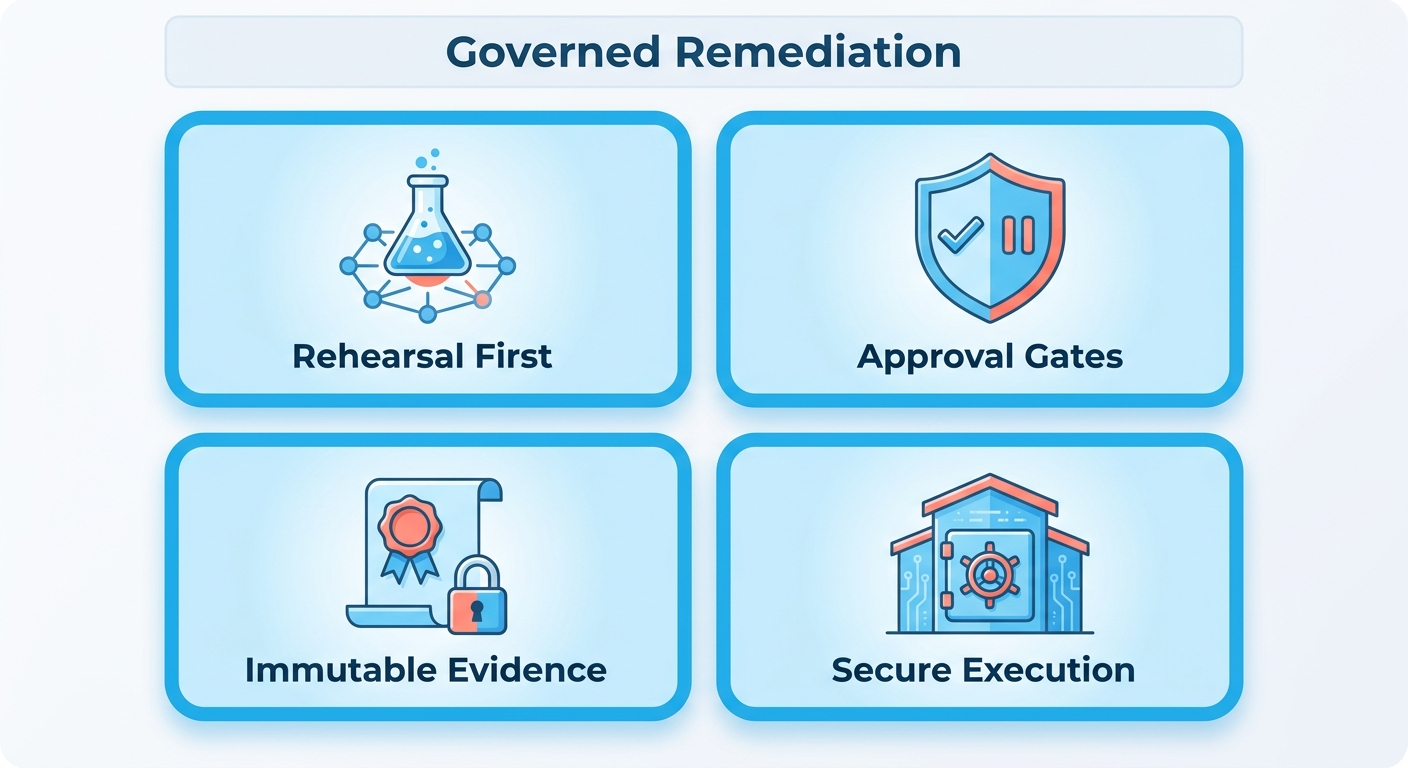 The four principles that make fast remediation safe enough for a security team to approve.
Implementing the Principles: How Regnor Changes the Workflow
The tools available to close this gap have historically been siloed: a monitoring stack, a configuration tool, a compliance scanner — none speaking to each other in a way that allowed rapid, safe action.
Regnor™, our visual workflow engine, is designed specifically to implement governed remediation. It is not a script runner; it is a control plane for network changes.
Visual Workflows a Security Team Can Read
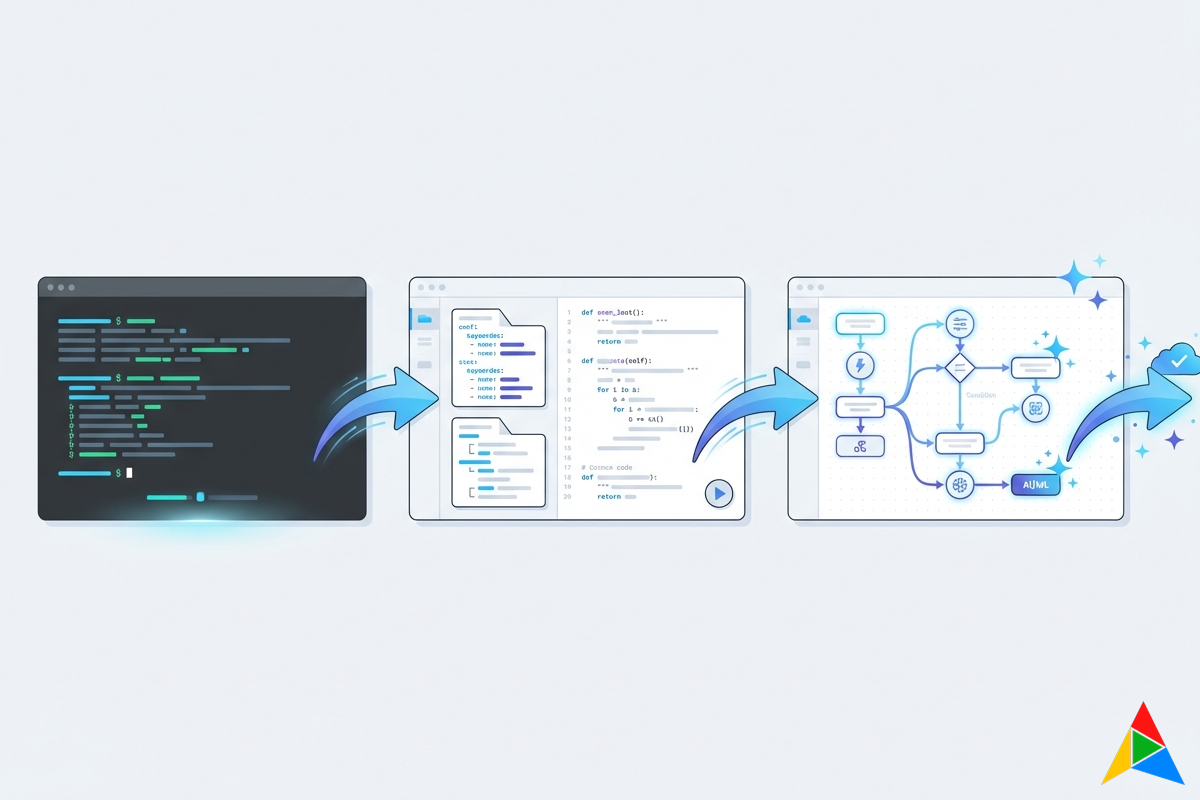
Regnor maps remediation logic in a visual interface with over 60 node types. This is not aesthetics — visual workflows make remediation logic auditable. A security team can look at a workflow and understand exactly what will happen when a drift event fires. That transparency is the first step toward the trust automation requires.
Rehearse-First: The Lab as a Safety Net
The most critical capability is proving a fix before shipping it. Regnor implements a rehearse-first model: a remediation workflow can clone a slice of production into a lab environment, apply the proposed fix there, and observe the outcome. Does the routing table stabilize? Does latency normalize? If the fix works in the lab, it is promoted; if it fails, production is untouched. This eliminates the fear of breaking the network — the primary reason teams hesitate to remediate quickly.
Pre-Flight Checks and Approval Gates
Regnor runs pre-flight checks before any change executes — verifying that no conflicting change is in progress, backups are current, and targets are reachable. And workflows enforce approval gates: pause after rehearsal, require sign-off from a designated owner, then proceed. This is not a bottleneck; it is a control. The system does the heavy lifting of analysis and simulation; the human provides the final yes.
Automatic Rollback with Checksum-Verified Restore
If a change degrades production anyway, Regnor triggers automatic rollback — not a loose “undo,” but a checksum-verified restore that returns the device to its exact pre-change state. That guarantee prevents the “drift within drift” scenarios that plague manual rollbacks.
The Compliance Layer: Tavrin™ and the Audit Trail
Speed without auditability is a compliance failure. Tavrin™, our compliance engine, ties remediation to a robust evidence chain: DISA STIG and CIS Benchmark templates validate network state before and after a change, and every action — who approved it, what was checked, what changed, the result — is sealed as WORM (Write Once, Read Many) audit evidence. Security teams aren’t approving a black box; they are approving a process that is fully documented and verifiable. That is what lets them say yes to automation at all.
Secure Execution: Valdis™ and Data Residency
The tooling that executes these workflows must itself be secure. Many platforms centralize credentials or ship data to cloud AI models — a non-starter for many enterprises.
Valdis™, our on-prem agent, runs inside the customer’s network. Credentials never leave it. The agent connects outbound-only and integrates with HashiCorp Vault, so secrets are never stored in plaintext. And for teams with data-residency requirements, our AI intent-to-workflow generation supports local LLMs — the AI that drafts your remediation logic can run entirely on-prem.
Multi-Vendor Reality
Governed remediation cannot be a single-vendor story. Regnor works through the libraries and protocols the industry already trusts — Netmiko, NAPALM, Ansible, NETCONF, gNMI — so the same governed workflow can remediate drift on a Cisco router, a Juniper switch, and an Arista device. We don’t ask you to rip and replace your toolchain. We add the governance layer it is missing.
The Honest Close
We are not claiming automation will replace the network engineer. We are claiming automation should replace the fear of the network engineer.
The detection layer has won. We can see everything. The question is no longer “can we see it?” but “can we fix it safely and quickly?” Scripts are too brittle. Manual processes are too slow. Naive automation is too risky.
Governed remediation is the synthesis: AI to identify the problem, simulation to prove the fix, human judgment to approve the action, immutable evidence to prove the process. It requires one shift in mindset — from “run this script” to “approve this workflow” — so the default state is safe, and the path to action is clear, audited, and reversible.
Join the Beta
Our integrated platform — Regnor, Tavrin, and Valdis as a single governed remediation stack — is in beta, and signups are open. We’re looking for NetOps engineers and engineering managers who are tired of the detection/remediation gap and ready to build workflows their security teams can approve. We onboard teams in cohorts.
Next step: Join the beta waitlist and tell us about your environment; we’ll follow up when your cohort opens.
Tags: ai-observability, beta, compliance, config-drift, governed-remediation, multi-vendor, network-remediation, regnor, tavrin, valdis
Categories: Network Automation, Security
Updated:
You may also enjoy
In today’s enterprise, the datacenter is no longer just a cost center. It is the operational backbone of revenue, customer experience, and competitive advant...

Most AI employees get fired in year one — canceled for cost, unclear value, or missing risk controls. The difference between a pilot and a workforce is wheth...
About Me

Featured Articles
Best Network Automation Tools in 2026: A Comprehensive Comparison
September 1, 2026Ready to Automate?
See how AutomateNetOps.AI can transform your network operations with zero-trust security.