
Rapidly Securing Datacenters in the Age of Advanced AI Models
Every network team is about to get very good at finding problems.
AI-assisted monitoring, drift detection, and log analysis are collapsing the time between “something is wrong” and “we know exactly what’s wrong” — from days to minutes. That part of the story is everywhere, and it’s real.
Here’s the part that isn’t in the keynotes: remediation hasn’t sped up to match. Knowing about an issue still funnels into the same pipeline it did a decade ago — a ticket, a change board, a maintenance window, one device at a time. The result is a new and uncomfortable operational state: a growing queue of problems you know about and haven’t fixed yet.
That queue has a name in security terms: exposure.
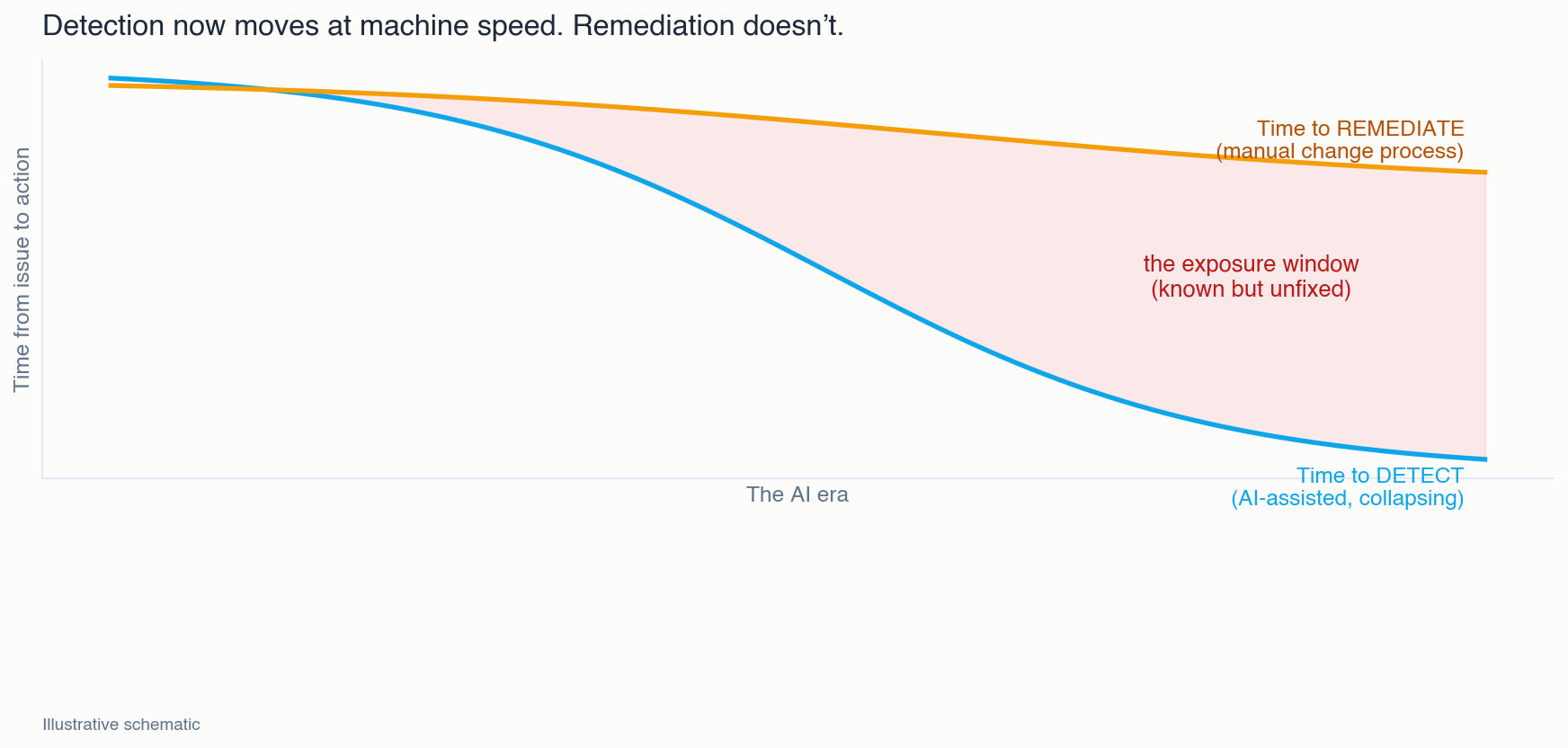 Detection is accelerating; remediation isn’t. The shaded region — known but unfixed — is the risk window that matters now.
The gap is measurable — and it’s governance, not tooling
The industry’s own numbers describe the imbalance. In Gravitee’s State of AI Agent Security 2026, 80.9% of technical teams reported moving AI agents past planning into testing or production — while only 14.4% of those agents went live with full security and IT approval, and barely half are actively monitored at all. Adoption is outpacing control, and the legal system has noticed: Gartner projects more than 2,000 AI-related legal claims by the end of 2026, driven by insufficient risk guardrails. Even the Department of Defense’s guidance on agentic AI now reads like an operations manual: least privilege, layered controls, human oversight on consequential actions.
The uncomfortable conclusion for infrastructure teams: the governance built for human-speed change — review meetings, sign-off documents, quarterly windows — cannot supervise machine-speed operations. Not because the policies are wrong, but because a policy document can’t park a running change. By the time a human reads the wiki page, the agent has finished.
If AI is going to remediate at the speed it detects, the controls have to live where the change happens: in the execution path.
What guardrails-as-architecture looks like
This is the design principle our platform is built around, and it’s concrete enough to draw:
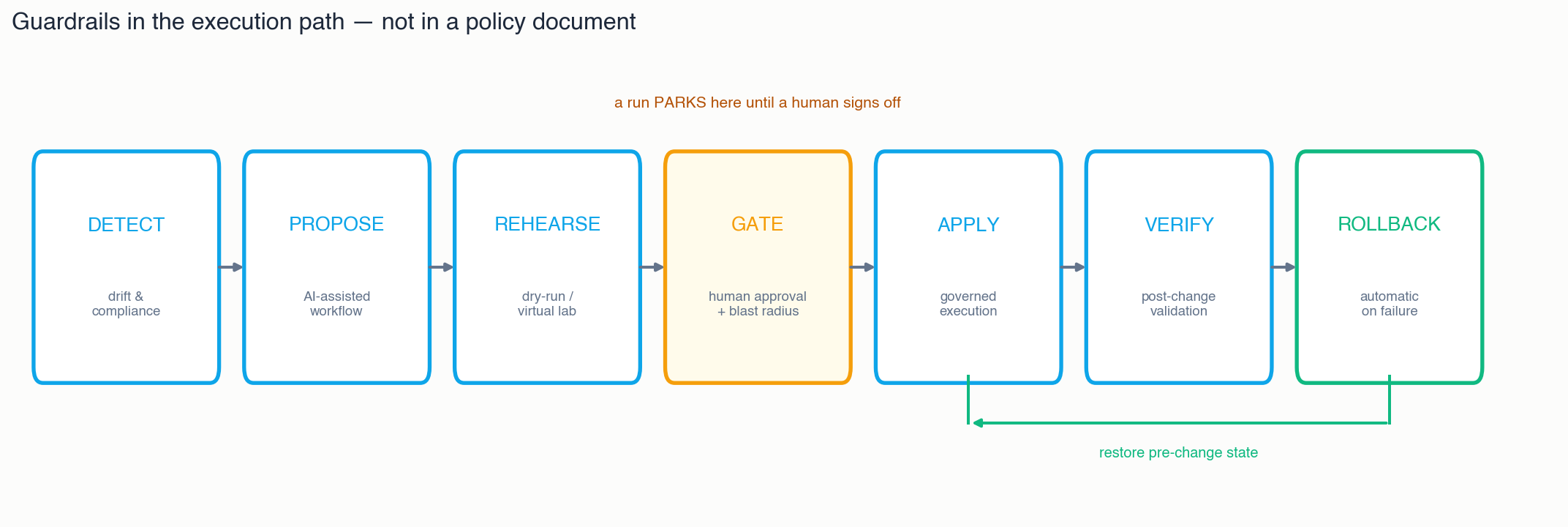 Every stage is enforced by the platform, not promised by a document. The amber gate is a real parked run awaiting a human.
Walking the pipeline:
- Detect — drift detection and compliance monitoring surface what changed and what’s out of policy, continuously.
- Propose — an AI-assisted workflow (or a ready-made template) turns the finding into a concrete, reviewable change.
- Rehearse — dry-run mode executes the change against nothing; virtual labs clone production topology so you can watch it fail somewhere safe first.
- Gate — the run parks, mid-flight, showing a human the blast radius before anything applies: how many devices, what fraction of the fleet. Approval is an action in the system, on the record — not a meeting minute.
- Apply — governed execution, credentials never leaving the customer’s site.
- Verify — the change proves itself: post-checks run automatically.
- Rollback — and when verification fails, the platform restores the pre-change state without being asked. Failure is a handled case, not an incident.
The speed insight is the whole point: none of these stages slows the machine down meaningfully — they slow the mistake down. A five-minute governed pipeline replaces a two-week change process, and the human spends their attention on the one decision that actually needs them.
Pro tip: when you evaluate any AI-operations product, ask one question first: “show me a running change parked at a human approval, displaying its blast radius.” If the vendor can’t, the guardrails live in a PDF.
The attacker is automating too
Everything above reads like an efficiency story. It’s also an adversarial one — because the same class of AI that’s accelerating your detection is accelerating the offense.
This is no longer hypothetical. In November 2025, Anthropic disrupted the first reported AI-orchestrated cyber espionage campaign: a state-sponsored group manipulated an agentic coding tool into attempting infiltration of roughly thirty organizations — with the AI executing 80–90% of the operation on its own. And the CrowdStrike 2026 Global Threat Report measured the average eCrime breakout time — initial access to lateral movement — at 29 minutes, with the fastest observed at 27 seconds and AI-enabled adversary activity up 89% year over year.
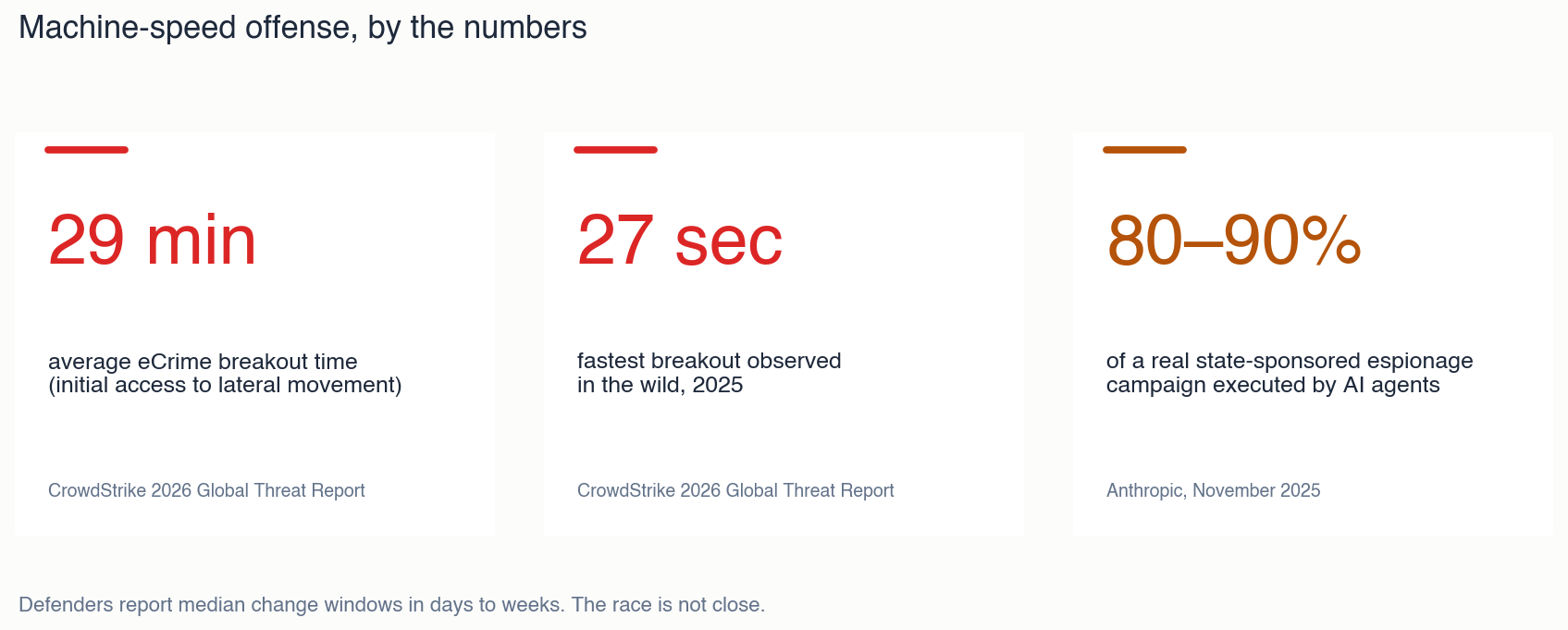 Attackers already operate at machine speed. Sources: CrowdStrike 2026 Global Threat Report; Anthropic, November 2025.
That changes what the exposure window from the first chart means. “Known but unfixed” used to describe a queue; now it describes a race — automated recon is sweeping for the same weaknesses your own scanners just found, and a fresh CVE can be weaponized before your change board convenes. Reacting to machine-speed attacks comes down to two capabilities:
Know your posture continuously. Audit-season compliance is a photograph; automated attackers work against video. Our compliance dashboard runs your baselines — hardening rules, organizational policy — against the fleet continuously, with per-device drift detection, so a device that slips out of policy becomes a finding in minutes, not a surprise in next quarter’s audit. Secure posture stops being a report you produce and becomes a live state you enforce.
Deploy defenses at machine speed — with governance. When a patch or a configuration defense has to go fleet-wide now — disable a vulnerable service, tighten an ACL, rotate exposed credentials, roll an updated OS image — an automated platform turns weeks of per-device tickets into one governed rollout: the same rehearse → gate → apply → verify → rollback pipeline from above, executed across hundreds of devices in minutes. The blast-radius gate is exactly what makes that speed survivable: you match the attacker’s tempo without inheriting their recklessness.
Racing a 29-minute breakout with a two-week change window isn’t a strategy. Governed automation is how patching stops being the slowest thing in your security program.
The fleet nobody puts on the slide
There’s a second gap AI-era security conversations skip: the gear that can’t be modernized. Real datacenters run switches, console servers, PDUs, and appliances that only speak older SSH — equipment that works fine, does its job, and would cost six figures and a maintenance window to replace for no operational gain. It’s also exactly the gear automated recon finds first: old firmware, old crypto, well-catalogued CVEs.
Most platforms handle that fleet in one of two bad ways: refuse to talk to it (so it silently exits automation and monitoring altogether), or quietly downgrade crypto to connect (so your security posture erodes without anyone deciding it should).
We built a third way: explicit, controlled consent. When a device requires legacy SSH algorithms, the platform names exactly what’s needed and why it’s weak, and a human approves it — per device, on the record, revocable. The legacy fleet stays managed, monitored, and automated, and every exception to modern crypto is a decision someone actually made. For most organizations that’s not an edge case — it’s the difference between automating the network they wish they had and the one they actually run.
You don’t have to invent remediation
The last piece of speed is not writing everything yourself. The platform’s marketplace carries ready-made remediation and compliance workflows — free and premium — that arrive already shaped like the pipeline above: rehearsal, gates, verification, rollback included. Adopt one, adapt it, or publish your own.
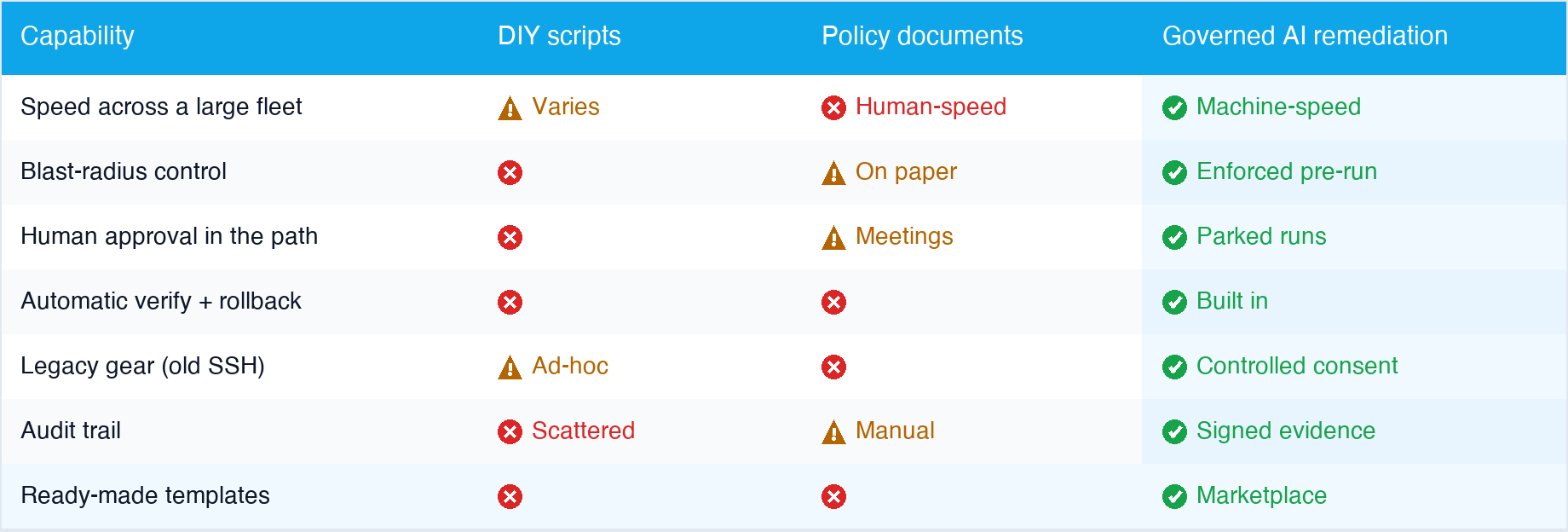 Three ways teams remediate today — click to zoom
We run our own company this way
One last data point, because it’s the one we can vouch for personally: our company is operated day to day by a governed AI workforce — support triage, reliability scans, security reviews — under exactly the guardrails described above.
Detection is getting faster for everyone — including for whatever’s wrong in your network right now. The teams that thrive in the AI era won’t be the ones that find problems fastest. They’ll be the ones whose fix keeps up with their find.
Join the Regnor™ beta and run your first governed remediation — or start with the free Change Safety course to see the Safe Change pattern taught on real gear.
Tags: ai-guardrails, ai-security, compliance, datacenter, drift-detection, legacy-ssh, network-automation, patching, remediation
Categories: Network Automation, Security
Updated:
You may also enjoy
For the better part of a decade, the narrative in network operations has been one of steady improvement. We built better sensors. We deployed faster probes. ...
In today’s enterprise, the datacenter is no longer just a cost center. It is the operational backbone of revenue, customer experience, and competitive advant...
About Me

Featured Articles

Ready to Automate?
See how AutomateNetOps.AI can transform your network operations with zero-trust security.